Translate

Saturday, August 24, 2013

Part 3: Who owned India?

India has been ruled by several dynasties, empires, and nations before it finally became the modern day Republic of India. At first, India was a collection of several Hindu city states if you will. However, in the the late 15th century, India was united under the primarily Muslim Mughal Empire along with Pakistan and Bangladesh.
Mughal flag
They ruled for nearly 400 years until the British took control and added Burma to the territory in the 1850s and Hinduism was restored. Besides the British, certain parts of India that is the modern day union territory of Pondicherry was ruled by the French and the state of Goa was ruled by the Portuguese. Eventually, Burma became a separate British territory.
British India flag
The British and other Europeans ruled India for almost 100 years until 1947 when India became independent. However, the Muslims in Pakistan and Bangladesh did not want to be in a nation unified with the primarily Hindu Republic of India. So Pakistan and Bangladesh seceded from India to form the modern day republic of Pakistan and Bangladesh. At first, Pakistan and Bangladesh were unified but that didn't go too well for them especially for Bangladesh, so with the help of India, Bangladesh became independent.
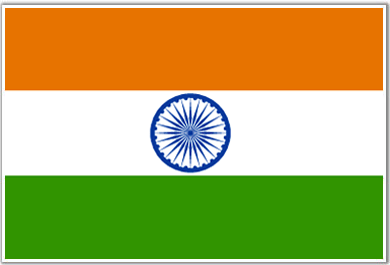
Modern-day Indian flag

Saturday, August 10, 2013

Part 2: Culture in India

Like I said in the last post, India's dominant religions are Hinduism and Islam. India also has significant minorities of Buddhists, Sikhs, Christians, and Jains. However, in most fields, HInduism is the dominant religion. India's major Hindu celebrations include Holi (Spring Festival), Ganesh Chaturti (Lord Ganesha's birthday), Krishna Janmashtami (Lord Krishna's birthday), and the biggest holiday in India: Diwali (Festival of Lights). The Muslim holiday of Eid-al-Fitr is also a national holiday. Most HIndus recognize the Ganges and the Yamuna rivers as sacred rivers.
India is the birthplace of several religions, among them Hinduism, Buddhism, Sikhism, and Jainism. Christianity spread to India because of the Europeans. India's religions ranked in terms of most followers in India are HInduism, Islam, Christianity, Sikhism, Buddhism, and Jainism.

Thursday, August 8, 2013

Part 1: The Geography of India

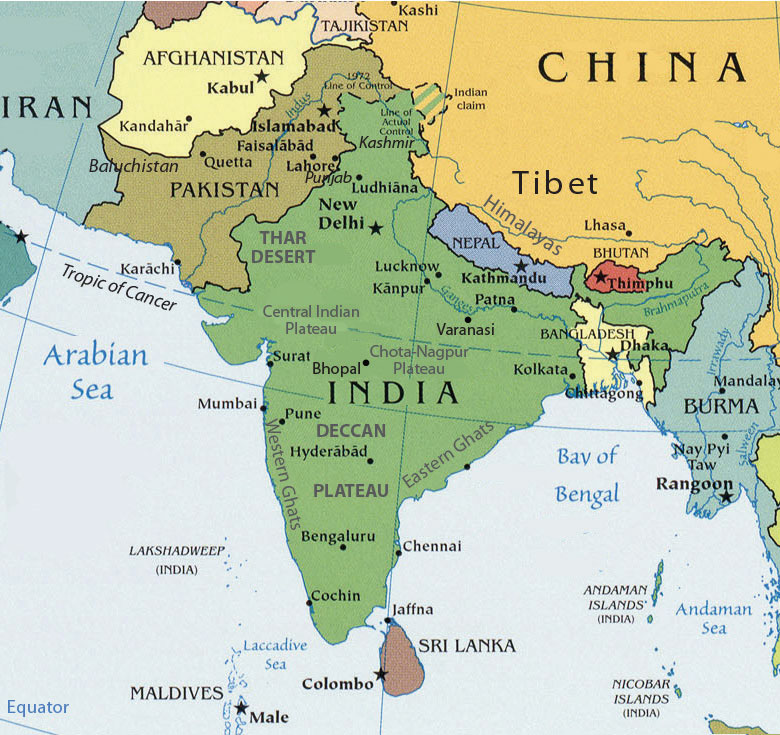
The Republic of India is the world's 7th largest country by area and the 2nd largest by population. It borders Pakistan to the northwest; China, Nepal, and Bhutan to the northeast; Burma and Bangladesh to the east; the Bay of Bengal to the southeast; and the Arabian Sea to the southwest. It consists of 28 states and 7 union territories. Here are some maps for your reference.
India is a very peaceful country, but it also has a relatively large amount of disputed territory compared to most other countries, the most notable being Jammu and Kashmir, Aksai Chin, and Arunachal Pradesh. Here's a map of that.
India has two domanint religions, Hinduism and Islam with followers comprising 80.5 and 13.4 percent of India's population respectively. India's two official languages for the nation as a whole are Hindi and English, however the states and union territories also have other official languages, and if you count these, India has 22 official languages. These languages include Marwari, Urdu, Tamil, Telugu, Gujarati, Rajistani, and even languages like French and Portuguese. India's states vary tremendously in population with Utter Pradesh, the most populous having approx. 199 million people, and the least populous, Sikkim having just over 600,000 people. India has 6 primary geographic regions. They are the Himalaya mountains, the desert region, the Ganges river basin, the Eastern Ghats mountains, the Deccan Plateau, and the coastal plain.

Author: Avi Goel